Athena An Interactive Musical Mystery™
Proudly Presents:
Prelude to a Dream Come True That Ignorance Turned Into a Living Nightmare
In November 1979, Iranian militants took American embassy personnel hostage in Tehran. As the crisis unfolded, Americans were also discussing the possibility of reinstating the military draft, including whether women should be required to register.
My upbringing and life experiences had already shaped how I viewed war, peace, and the responsibilities we have toward one another.
I remember a conversation with my grandfather, who had served in the Army in the trenches of France during WW I.
He told me that if the Christmas Truce of 1914 had been allowed to continue, he believed the war would have ended right then and there. And he would never have found himself praying to God to end the nightmare of trying to survive trench warfare.
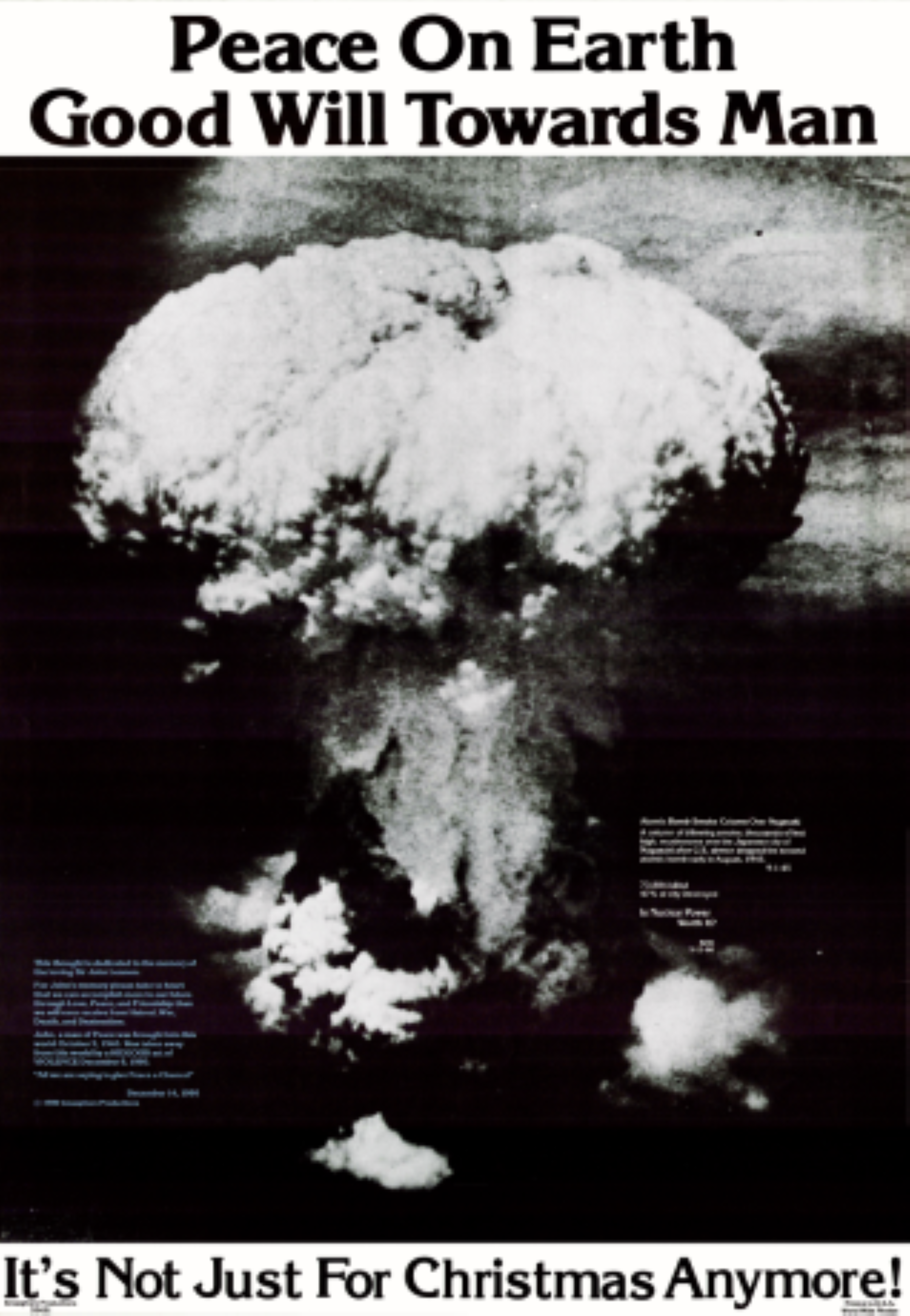
Against that backdrop, I came up with an idea for a poster featuring the atomic mushroom cloud over Nagasaki, accompanied by a message:
“Peace on Earth Good Will Towards Man. It's Not Just for Christmas Anymore.”
In May of 1980, I had 1,500 copies of my poster printed.
I had no idea at the time that this poster would eventually become the centerpiece of Athena An Interactive Musical Mystery™.
The Death of John Lennon
On December 8, 1980, I was watching Monday Night Football when Howard Cosell announced that John Lennon had been shot outside his apartment building in New York City and rushed to Roosevelt Hospital, where he was pronounced dead on arrival.
I specifically remember Cosell going on to describe Lennon's murder as an assassination, possibly near the end of the football broadcast. It might have been his segue into promoting that night's ABC Nightline broadcast, which would be devoted to Lennon's death.
I had been a Beatles fan ever since watching their first appearance on The Ed Sullivan Show in February 1964.
Just over a year before Lennon's death, I had met and talked with him and Yoko Ono while roller skating through Central Park, without realizing who he was.
Even though Lennon kept dropping hints about the Beatles into our conversation, it never dawned on me that I was talking to John Lennon. Not even when he asked me who my favorite Beatle was.
Looking back on that conversation, I sometimes feel foolish for not recognizing him. But I also feel grateful that I unintentionally gave him the gift of anonymity by treating him just as I would treat any other human being.
I later learned from an interview that Lennon enjoyed being able to go out in public without being recognized.
Knowing that, I'm glad I didn't recognize him that day. I hope he enjoyed our conversation as much as I do remembering it.
Why Would I Add a Dedication I Wrote for John Lennon Onto My Poster?
There were several reasons why I decided to write a dedication to John Lennon and have it printed on the remaining copies of my poster.
The main reason was his peace activism.
I realized that someone had stolen the opportunity for me to someday show Lennon my poster and ask him what he thought about it. I believed he would understand what I was trying to accomplish by having more than a thousand copies of it printed.
But there was another reason, one that made me think more deeply about the message on my poster.
My poster was about peace on Earth. And I realized that peace wasn't just about creating a world without wars. It was also about creating a world where one human being wouldn't take the life of another.
And the dedication I wrote for John Lennon allowed me to highlight that second reason perfectly.
I wasn't trying to capitalize on Lennon's death. I could just as easily have written a dedication to President John F. Kennedy and had it printed on my poster instead.
But Kennedy was the President of the United States, a political figure whose position and decisions inevitably created enemies.
John Lennon, on the other hand, was a musician and peace activist. People might have agreed or disagreed with his views, but those disagreements were certainly no reason to take his life.
His murder, like so many other senseless killings, simply didn't make sense to me.
And I believe Lennon's death brought that realization home to many people in a way that even Kennedy's assassination had not.